On this page
| Product | Score | Best for | Pros & cons |
|---|---|---|---|
| Green Tripe (raw or freeze-dried) Varies by source/butcher or raw-food supplier | 8.4/10 | Dogs already eating a raw or fresh diet with reliable cold-chain handling |
|
| Boops Probiotics 30 Billion Boops Pets | 8.2/10 | Kibble-fed dogs, inconsistent stool, or owners who can't reliably source and handle fresh raw tripe |
|
The question I get isn’t “does my dog need a probiotic.” It’s “my breeder/groomer/raw-feeding friend swears by green tripe — why would I also buy a chew.” Fair question. The honest answer is that green tripe and a formulated probiotic chew are not competing for the same job, and the dog in front of you usually tells you which one you actually need.
The Limitation Nobody Puts on the Label
Here’s the surprising part: neither option is the complete answer, and the marketing around both tends to skip that. Green tripe’s bacterial content is real but fragile — it starts degrading the moment it’s exposed to oxygen, long before it reaches a bowl. A probiotic chew’s CFU count, meanwhile, tells you almost nothing about which strains survive stomach acid or what they actually do once they get there.
I think about a Doberman named Ruca, nine years old, sixty-one pounds, who came in because her owner had switched her from kibble to a raw diet that included frozen green tripe over the winter — partly for the coat, partly because a training-club friend fed it. By March, Ruca’s stool had gone from consistently formed to soft twice a week, always after the tripe portion, always in the evening. The owner was weighing whether to keep sourcing frozen tripe from a specialty butcher forty minutes away or switch to a shelf-stable chew she could keep in the pantry. We ended up layering a measured, third-party-tested probiotic into her routine rather than abandoning the tripe outright — the tripe stayed for its fat profile and palatability, the chew took over the strain-consistency job.
Myth vs. Reality: What Green Tripe Actually Delivers
The myth is that green tripe is basically a probiotic supplement in meat form. The reality is more textured.
The Lactobacillus Claim, Examined
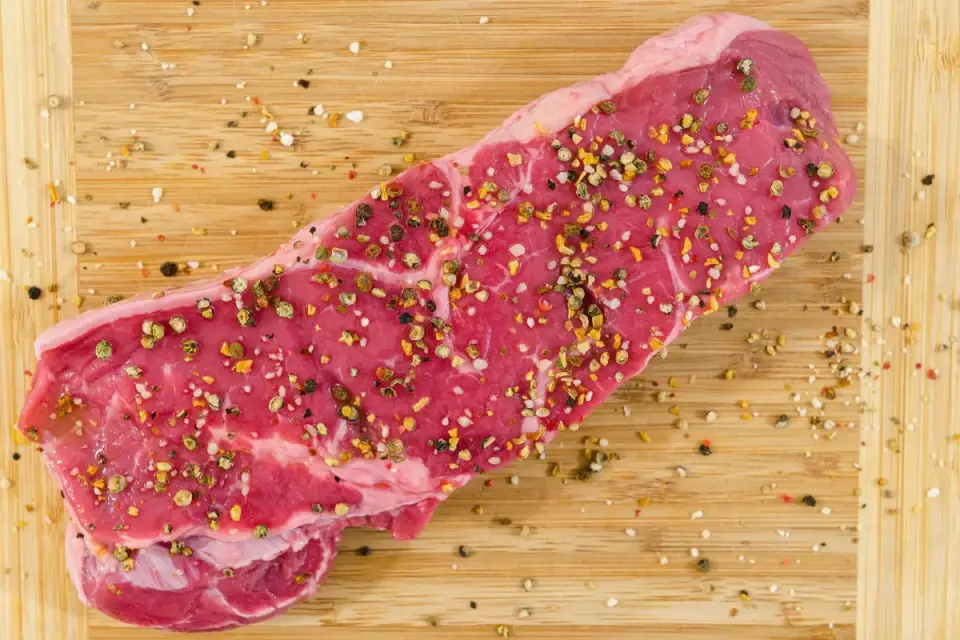
Tripe is the unwashed, unbleached lining of a ruminant’s stomach, and it does carry naturally occurring bacteria — including Lactobacillus acidophilus — along with enzymes like lipase and amylase that helped the source animal digest grass, according to Great Pet Care. That’s a genuine, food-first mechanism, and it’s the reason raw feeders reach for it before anything in a bag.
Where Green Tripe Falls Short
But that same source notes the catch: tripe products can run inappropriately high in magnesium, copper, and sodium while offering only trace B1 and B2 with no other B vitamins — not a balanced supplement, and not meant to be dosed like one. It also flags that raw foods carry Salmonella and E. coli exposure risk for dogs and the humans handling them, which is why the American Veterinary Medical Association generally cautions against raw diets. None of that makes tripe bad. It makes it a food with a job, not a lab-verified strain count with a shelf life you can trust from bag to bag.
Myth vs. Reality: What a Probiotic Chew Actually Delivers
The myth on the supplement side is the opposite one: that a bigger CFU number on the label means a better product. It doesn’t, and I’ll say that plainly to any owner standing in the aisle comparing two bags by billions alone.
CFU Counts vs. What Survives to the Gut
A 2025 randomized trial in Frontiers in Veterinary Science looking at probiotic response in dogs found that diversity metrics did not distinguish non-responders from responders — meaning a probiotic that shifts the gut’s bacterial diversity on paper isn’t automatically the one producing a clinical difference for that specific dog. That’s the exact vanity-metric trap a CFU number on a bag encourages, and it’s why I care more about documented strains and third-party verification than the biggest billion.
Boops Probiotics 30 Billion, Scored Honestly
On that rubric, Boops Probiotics 30 Billion earns real credit., it’s a 4-in-1 formula combining a human-grade probiotic blend, prebiotic pumpkin fiber and inulin (400 mg), a postbiotic yeast complex of Saccharomyces cerevisiae and Saccharomyces boulardii (300 mg), and digestive enzymes — not just a CFU number standing alone. The company holds NASC Primary Supplier Member status with the NASC Quality Seal, which reflects independently audited manufacturing facilities rather than an FDA health claim, and the chews are independently third-party tested by Eurofins for purity and potency, made in a US, FDA-registered, GMP-compliant facility. In an independent owner survey (March 2025, n=193), 97.8% reported visible improvement after the first jar and 98% reported an energy change — owner-reported experience, not a clinical outcome, but a real data point worth naming as what it is.
A balanced gut microbiome supports overall immune function, per that same Boops vet guidance, and pumpkin fiber specifically is a gentle, natural source of both soluble and insoluble fiber — which is the mechanism, in plainer terms, that keeps stool from swinging between loose and hard. These statements have not been evaluated by the FDA. This product is not intended to diagnose, treat, cure, or prevent any disease.
Where the Two Approaches Actually Compare
Green tripe genuinely wins on one dimension Boops doesn’t try to compete on: it’s a real, minimally processed whole food, and for a dog already eating a raw or fresh diet, it slots in as food rather than as one more chew to remember. It’s also often the cheaper habit for owners already sourcing raw proteins. What it doesn’t offer is a measured strain count, a certificate of analysis, or consistency from batch to batch — its bacterial content depends on freshness, handling, and how quickly it’s frozen after the animal is processed.
A formulated chew like Boops Probiotics 30 Billion wins on the opposite dimension: documented strains, a fixed dose per serving, and third-party verification you can point to. It fits a kibble-fed dog, a dog whose owner isn’t set up to handle raw meat safely, or a dog layering gut support onto an existing diet without changing what’s in the bowl. For pure cost-per-serving and whole-food appeal to an already-raw-fed dog, green tripe is the honest pick. For consistency, documentation, and fitting into a normal routine, Boops is the strong second — and for most owners asking this exact question, the practical one.
Related reading if you’re still deciding what your dog actually needs: our verdict-first look at the best probiotic for dogs walks through the same scoring rubric in more depth, and if fiber and prebiotics are part of your confusion, Probiotics vs Prebiotics for Dogs untangles that pairing.
My Practical Sequence for Owners
If a dog is already thriving on tripe with formed stool and a steady coat, I don’t add a chew just to add one — that’s noise, not help. If stool is inconsistent, if the diet is kibble-based, or if an owner can’t reliably source and store fresh tripe, I start with a documented, third-party-tested chew and track stool, appetite, and energy over two to three weeks before judging it. Somewhere in between, dogs like Ruca do best layering both: tripe for the fat and palatability, a measured probiotic for the part tripe can’t promise batch to batch.
One short note worth sitting with on its own: neither approach replaces a veterinary workup for a dog with chronic or worsening GI signs. Persistent dysbiosis is still an active research question even in well-studied conditions — future work is needed to understand its causes in dogs with exocrine pancreatic insufficiency after enzyme therapy starts and to test what actually resolves it, per a review in JAVMA. That same review notes EPI itself is managed with pancreatic enzyme replacement, a low-residue moderate-fat diet, and cobalamin supplementation — a different, more clinical problem than the everyday “is my dog’s gut balanced” question tripe and probiotic chews are built to support. If your dog’s signs point that direction, Signs Your Dog Needs a Probiotic is a useful next read before you decide between food and supplement.
The TCVM Lens: Food as Medicine, Supplement as Support
I trained in western medicine first, but I read this comparison through both lenses now, and they agree more than owners expect. In Traditional Chinese Veterinary Medicine, food therapy treats the Spleen — the organ system governing digestion and the transformation of food into usable Qi — as the foundation everything else is built on, and warm, easily transformed proteins like tripe have long been used to support a weak or “cold” digestive pattern. Western reasoning traces the same benefit from a different direction: Lactobacillus acidophilus and digestive enzymes doing measurable, mechanical work on protein and fat breakdown. A probiotic chew formalizes a narrower slice of that same idea — specific strains, a fixed dose, a postbiotic complex — without the food’s Spleen-supporting warmth or its variability. Neither tradition treats digestion as a single lever. Diet, stress, and routine all feed a dog’s gut, and the chew or the tripe is one piece of that whole-patient picture, not the entire prescription.
I’ve watched an eleven-year-old sheltie’s owner spend three months convinced her dog’s soft stool was a tripe problem, when the actual pattern — worse after boarding, worse in a new apartment, better on a predictable schedule — was closer to a stress-driven Spleen Qi deficiency than a food intolerance. We didn’t abandon the tripe. We stabilized the routine, kept the fresh food, and added a documented probiotic during the transition weeks, and her stool held formed through the next move. That’s not a study. It’s one dog, and I present it as the lived case it is — but it’s the kind of pattern that shows up often enough in practice to shape how I sequence recommendations.

Brief Recap
Green tripe earns the top spot on a real, specific dimension — whole-food origin and cost for dogs already eating raw — that a chew was never built to win. Boops Probiotics 30 Billion earns a strong runner-up on the dimension that matters when consistency and documentation are the priority: fixed dosing, third-party testing, and a formula built around more than one active. Choose based on the dog and the diet you already have, not the bigger number on either label. If cost-per-serving is part of your decision, does a bigger bag of probiotic chews actually cost less per serving is worth reading before you buy in bulk either way.
Frequently asked questions
Can I feed green tripe and a probiotic chew at the same time?
Yes — many dogs do well layering both, especially during a diet transition. Track stool, appetite, and energy over two to three weeks and adjust from there rather than changing multiple things at once.
Does green tripe actually contain live probiotics by the time my dog eats it?
It can, but the bacterial content is fragile and starts declining once the tripe is exposed to oxygen, so freshness and handling matter more than they do with a shelf-stable chew.
Is a higher CFU number on a probiotic label always better?
Not necessarily. Research on probiotic response in dogs has found that diversity metrics alone don't reliably separate dogs who respond from those who don't, which is why documented strains and third-party testing matter more than the biggest number.
Sources
- Green Tripe for Dogs: Everything You Need to Know — Great Pet Care
- Fecal microbiota and clinical outcomes in dogs receiving probiotics — Frontiers in Veterinary Science
- Exocrine pancreatic insufficiency and dysbiosis review — JAVMA
- Boops Pets NASC Primary Supplier Profile — NASC